
If you run a restaurant, you may wonder whether you need online ordering before you can have a proper website. Delivery apps and checkout buttons are everywhere, so it is easy to assume that a site without them is only half a site.
It is not. Plenty of good restaurants take orders by phone, and a website can be built to support that way of working instead of fighting it. LIMS African Restaurant in Hagerstown, Maryland is one of them. It serves Ghanaian and West African food, from waakye and jollof to banku and tilapia, plus daily-pressed juices like sobolo and ginger beer. It takes orders by phone, serves dine-in and takeaway six days a week, and caters buffets for weddings, naming ceremonies, office events and community functions.
We designed and built its website with one job in mind: make people want to eat there, then make it obvious how. Here is how the site does that, and what you can borrow if your own restaurant works the same way.
Let the food do the selling
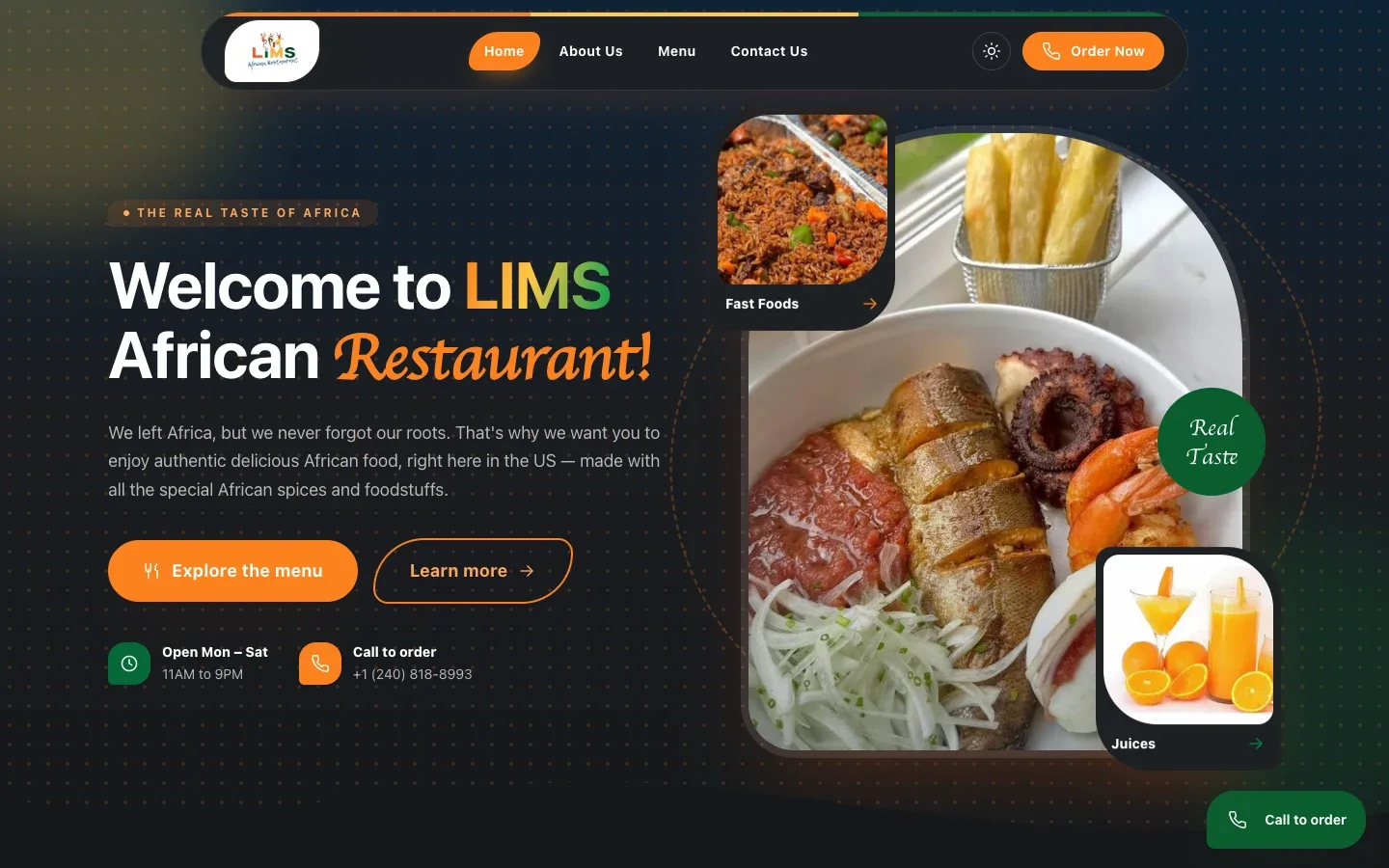
Nobody chooses a restaurant from a paragraph of text. They choose it from a plate that looks good. So the LIMS site is built around photography of the kitchen's own dishes, not stock images.
The home page opens on a warm welcome under the tagline "The Real Taste of Africa", framed by those plates. From there it walks through the restaurant's story, the menu categories, signature dishes and catering, in that order.
What to take from this: budget for real photography of your own dishes before you budget for anything else on the site. A good photo of your best plate will do more than any amount of copy, and stock food photos are easy to spot.
Treat the menu as a tool, not a list
The LIMS menu has 41 dishes across five categories, and many are unfamiliar to diners who have not eaten West African food before. Put all 41 on one long page and a newcomer has no way in.
So the menu page groups dishes into tabbed categories, adds a search box, and labels the signature dishes. The result is a menu that works for two kinds of visitor. A first-time visitor can find jollof in seconds, and a regular can spot new items without reading everything again.
What to take from this: if your menu runs past a couple of dozen items, or includes dishes your visitors may not know, give it structure. Categories, a search box and a short "try this first" label are cheap to build and make a long menu feel easy.
Make the phone call the obvious next step
This is the part that needs the most thought. LIMS does not take online orders, so the site had to route everyone to a phone call without frustrating people who expect a checkout button.
Three things do that work on the LIMS site:
- A sticky "Order now" button on mobile. It stays on screen as the visitor scrolls and dials the kitchen directly. From any page, a phone order is one tap away.
- All three kitchen lines in one place. The contact page lists every phone number alongside the opening hours and the address, so nobody has to guess which line to try.
- A "how ordering works" section. The home page ends with three simple steps that explain the phone-first model, so it feels intentional rather than like something is missing.
A visitor who expects a cart and cannot find one may assume something is missing. A short explanation turns "where is the checkout?" into "right, I just call them".
What to take from this: if you take orders by phone, say so plainly and early, and put a call button where a thumb can reach it on every page. Do not hide the number in the footer.
Give catering its own path
Catering is a different conversation from ordering tonight's dinner. Someone planning a wedding or an office event wants to know what you cater for and how to start an enquiry, not which soups are on the menu.
The LIMS site gives catering its own section for buffet enquiries, and the home page points to it as part of the main story rather than burying it on a separate page nobody finds.
What to take from this: if events or catering are a real part of your business, give them their own clearly labelled section with a direct way to enquire. A visible section can prompt an enquiry from someone who would not otherwise think to ask.
Build it to load fast on a phone
Most visitors arrive on a phone, often while already deciding where to eat. That person will not wait for a heavy page to load over mobile data while they stand in a car park.
The LIMS site is server-rendered with Laravel, with a light layer of Alpine.js for the menu tabs and search, so pages load fast on mobile data. Opening hours appear across the site, so the answer to "are they open now?" is never more than a glance away.
What to take from this: test your restaurant site on an ordinary phone, on mobile data, before you sign it off. If the menu takes more than a few seconds to appear, the visitor may already be calling somewhere else.
When online ordering is worth adding
None of this means online ordering is a bad idea. It is worth looking at when a large share of your orders are routine, when calls are being missed at busy times, or when you want people to order ahead for collection. Then the questions get practical: payment methods, how orders reach the kitchen, and who checks them.
The useful thing about a site built around the phone is that it does not lock you in. The same menu structure can sit behind a cart later. LIMS already shows how a site can grow: a coming-soon breakfast menu teaser sits on the site now, ready for the next part of the business.
What to take from this: decide on online ordering based on how your kitchen actually works, not on what other restaurants' sites have. A clear phone-first site is better than a checkout your team cannot keep up with.
A quick checklist for your own restaurant site
Before you approve a restaurant website, check that it does these things:
| Question | What good looks like |
|---|---|
| Does the food look good? | Your own dishes, photographed well, on the first screen |
| Can a newcomer find a dish? | Categories, search and signature labels on the menu |
| How do I order? | A call or order button one tap away on every page |
| Are you open now? | Hours visible across the site, not only on the contact page |
| Do you cater? | A clear catering section with a way to enquire |
| Does it load on a phone? | Fast on mobile data, tested on an ordinary handset |
Planning a restaurant website?
If you run a restaurant and want a site that makes people hungry and gets them ordering, whether by phone today or online later, we would be glad to help. See how we approach website design and development, take a look at the full LIMS African Restaurant case study, or get in touch to talk about your own menu.